One Big Beautiful Bill Act (OBBBA) – From GILTI to NCTI in 2026

The Global Intangible Low-Taxed Income (GILTI) regime—now officially renamed Net CFC Tested Income (NCTI) under the OBBBA—is essentially a low-tax “kick-in” designed to capture income from offshored intellectual property and other active business income that was previously deferred or excluded under Subpart F rules.Originally enacted in the Tax Cuts and Jobs Act (TCJA), the GILTI regime was intended to capture “extranormal profits”—income above a routine return on physical assets. The One Big Beautiful Bill Act (OBBBA) made significant changes, renaming GILTI as Net CFC Tested Income (NCTI) and shifting it toward a more comprehensive worldwide system with enhanced blending of income and taxes.The removal of the QBAI deduction, combined with revised expense allocation rules, has a profound effect on final tax liability:
Effective Rate
The changes push the effective NCTI rate to 14%, which is still lower than the 15% minimum rate proposed under the Pillar 2 international tax initiative. The reduction of the foreign tax credit (FTC) limit to 80% further ensures the effective rate stays below 13%, undercutting U.S. negotiators’ prior argument that GILTI’s effective rate often exceeded the statutory rate because of expense allocation.
Significance of Blending
Blending income and losses across jurisdictions is considered more valuable to U.S.-parented taxpayers than QBAI, since QBAI in low-tax intangible jurisdictions was typically insignificant.
Unallocated Interest Expense
Interest expense not allocated to NCTI is instead shifted to U.S.-source income. This can generate or increase overall domestic losses (ODLs), which are then allocated pro rata to the foreign tax credit baskets. In practice, this reduces the taxpayer’s ability to claim FTCs by lowering foreign income—effectively a backdoor allocation of interest expense to NCTI.In summary: Congress adopted most of the changes to GILTI that European negotiators had pushed for, while preserving blending. As a result, the effective NCTI rate remains below 15%. Absent foreign taxes, the actual NCTI rate falls below the statutory rate.
The transition from the Global Intangible Low-Taxed Income (GILTI) regime to the Net CFC Tested Income (NCTI) regime, primarily enacted through the OBBBA (One Big Beautiful Bill Act), represents a definitive move by the U.S. toward a full worldwide tax system for certain foreign income.The shift fundamentally alteres the mechanics of the tax, removing a key deduction and adjusting tax credit limits to increase the effective tax rate on profits from foreign subsidiaries.
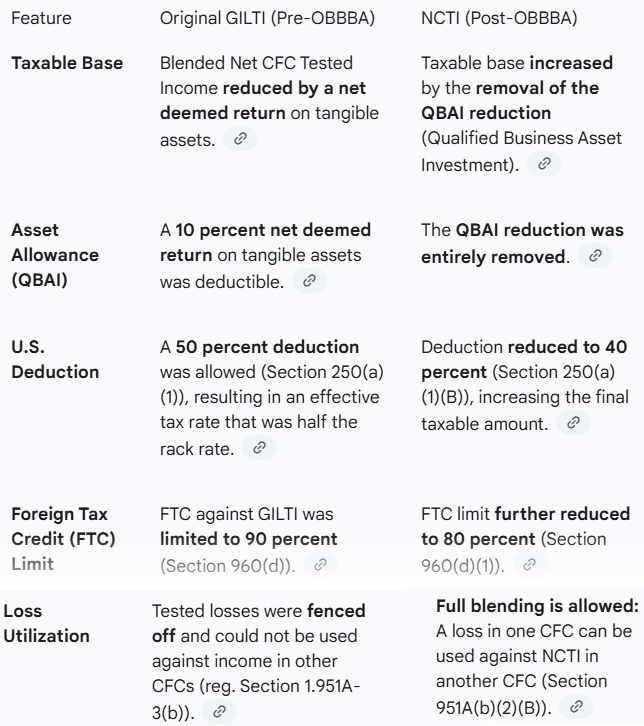
Under the GILTI regime, the US taxpayer could benefit from holding their interest in the foreign entity via a US C Corporation. Even without this structure, the US shareholder could elect, under section 250, to treat the the foreign entity as if it were held by a US C Corporation The lower tax rate enjoyed by a U.S. taxpayer on foreign company income under GILTI was achieved by holding shares in the foreign company via a U.S. C Corporation, which claimed the Section 250 deduction. Fortunately, this mechanism still applies under the new Net CFC Tested Income (NCTI) regime, but the tax benefit has been reduced.Here is how the system works for a U.S. C Corporation under both regimes:Continuation of the Lower Rate (Section 250 Deduction)
- Original GILTI (Pre-OBBBA): A U.S. C Corporation was granted a 50 percent deduction under Section 250(a)(1) on its GILTI inclusion. This deduction produced a rate that was half the standard corporate tax rate (which was 21% under the TCJA), allowing the C Corporation to pay a significantly reduced effective tax rate on that foreign income.
- NCTI (Post-OBBBA): The OBBBA preserved the mechanism of the Section 250 deduction for the NCTI inclusion but reduced the percentage from 50 percent to 40 percent.
Impact of the Change
The reduction in the deduction percentage means that while the C Corporation still benefits from a preferential rate, the effective tax rate on the income has increased:
- Increased Taxable Income: By reducing the deduction to 40%, the amount of foreign income subject to the full U.S. corporate tax rate has increased.
- Loss of QBAI: The removal of the QBAI (Qualified Business Asset Investment) reduction under NCTI further increases the taxable base, especially for U.S. shareholders who typically did not have significant QBAI in low-tax countries.
- Reduced FTC Limit: The Foreign Tax Credit (FTC) limit against NCTI was also reduced to 80 percent (down from 90 percent).
In summary, a U.S. C Corporation remains the beneficial vehicle for claiming the preferential tax rate on this foreign income, but the preferential treatment is less generous under the NCTI regime.
One Big Beautiful Bill Act Aligns U.S. International Tax Rate with Global Norms
One Big Beautiful Bill Act (OBBBA) has brought the statutory rate on international income in line with international norms.
Following on from a previous video discussing the shift from the Global Intangible Low-Taxed Income (GILTI) regime to the Net CFC Tested Income (NCTI) system, it makes sense to highlight the change in the statutory rate.
Under the Pillar Two agreement, the global focus centered on a 15 percent benchmark for international corporate income tax rates. The U.S. GILTI system, however, appeared to have a rate below 15 percent—in theory, as low as 10.5 to 13.125 percent. In practice, though, GILTI’s provisions often resulted in higher effective rates.
The OBBBA effectively traded away some of those GILTI idiosyncrasies to cut taxes for corporations, while raising the statutory rate to a range of 12.6 to 14 percent. This was roughly a neutral trade but gives the U.S. a headline rate more consistent with global norms.
One such idiosyncrasy was how the U.S. credited its companies for foreign taxes paid. Under the Tax Cuts and Jobs Act (TCJA), the U.S. credited just 80 percent. Falling short of 100 percent—the standard under Pillar Two—discourages jurisdictions from raising corporate taxes too high but also exposes U.S. companies to double taxation. The OBBBA raised the foreign tax credit to 90 percent, reflecting the global rise in corporate tax rates to comply with Pillar Two.
Another U.S. quirk removed by the OBBBA was the “indirect expense allocation” provision, which required certain deductions to be applied more heavily against foreign income and less against U.S. income. This effectively subjected some income—typically considered international—to the full 21 percent domestic rate.
With mounting pressure to reach a 15 percent nominal tax rate, it made sense to eliminate these unusual provisions and instead derive revenue through a simpler NCTI tax rate.



Looking for an international tax service?
We’re always here to help. Don’t hesitate to get in touch.
Talk to an expert