
Which Is the Best Offshore Asset Protection Trust? Cooks, Nevis, or Norway?

On this page
The results will surprise you!
Some argue that the Cook Islands is the best we did a comprehensive guide here
–https://htj.tax/2024/10/lets-talk-about-asset-protection-trusts-in-the-cook-islands-and-nevis/
Here are some of the pros –
- Foreign judgements are not recognized in Cook Islands courts – A creditor can have no claim against the assets of a Cook Islands trust if those assets were settled before the creditor’s cause of action accrued. This means that a Cook Islands trust offers unparalleled protection against unknown future creditors. Existing creditors seeking to claim the assets held by a Cook Islands trust are required to initiate legal action in the Cook Islands before the two-year statute of limitation expires, making a lawsuit a matter of urgency for the plaintiff. If a plaintiff wishes to proceed they would be required to retain a local law firm in the Cook Islands, pay legal fees up front and prove beyond reasonable doubt that the trust was established with the intent to defraud them. All of which produces a lengthy and costly process for a creditor that will almost always induce them to abandon or settle a frivolous claim.
- While asset protection is often the main objective of a Cook Islands trust, estate and succession planning is a significant advantage to the jurisdiction. With no rules against perpetual trusts, a Cook Islands trust can last indefinitely if a settlor wishes it to do so, making it a great legal vehicle for estate planning purposes. In addition to this, foreign inheritance laws, such as forced heirship, are not recognized in the Cook Islands with the inheritance of trust assets being determined by the terms of the trust agreement. With these advantages a Cook Islands trust can benefit multiple generations in perpetuity.
- Suitable for High-Risk Individuals: Cook Islands Trusts are especially beneficial for people in high-risk occupations, such as physicians and lawyers, business vendors nearing retirement, directors of public companies, and those with a high wealth profile. Almost anyone who has accumulated a significant nest egg for their retirement can benefit from these Asset Protection Trusts.
- Asset Preservation in Times of Duress: Assets held in a Cook Islands trust are protected even under duress. This means that when an individual is under increased legal pressure or financial uncertainty, the trust remains intact and safeguards the individual’s wealth.
Here are some of the cons –
- It’s on certain black lists. Depending on what you’re trying to do, this can have unwanted tax and legal consequences. One of the main concerns surrounding these trusts is the perception of illegitimacy. The Cook Islands has gained a reputation for being a tax haven, which may lead to negative assumptions about the intentions of those using these trusts. However, it’s essential to keep in mind that the Cook Islands has enacted Combating the Financing of Terrorism and Anti-Money Laundering systems to maintain compliance with international standards.
- Another drawback is the limited control the settlor has over the trust assets. The trustee, often located in the Cook Islands, has the ultimate discretion in managing the assets to ensure asset protection. This may lead to unforeseen issues, especially if there’s a breakdown in communication between the settlor and the trustee.
- Setting up a Cook Islands Trust can also be costly. There are fees associated with creating and maintaining the trust, as well as potential taxation implications. Be prepared for these financial obligations.
What about Nevis? We discussed it here
– https://htj.tax/2024/10/lets-talk-about-asset-protection-trusts-in-the-cook-islands-and-nevis/
Here are some of the pros –
- Perhaps the most unique benefit of a Nevis Trust is that to commence legal action, it requires a creditor to post a $100,000 U.S. bond. A bond of such magnitude will help in creating a protective shield against frivolous claims while ensuring that serious allegations are allowed to proceed.
- One of the neater aspects of trust law in Nevis is that of self-settled trusts. Under these circumstances, the settlor can both be a beneficiary, and this is certainly one of the major features that are not so often available around the world in so many jurisdictions. This unique aspect accorded accords provides the settlor flexibility to have his cake and eat it- he could savor the benefits of the trust assets while still hiding behind a protective armor against prospective claims.
- Short Statute of Limitations – The fraudulent conveyance statute of limitations in Nevis is famous for its shortness – one to two years. It means any challenges regarding transferring assets into the trust must be done within this time window.
- Non-Recognition of Foreign Judgments – The feature of Nevis Trusts is premised on their strategic non-recognition of foreign judgments. This is to mean that shall be the conceivable course of a truly legal challenge of the trust to start from scratch in Nevis and independently of any judgment passed on another country.
Here are some of the cons –
- Like the Cook Islands, it is expensive to set up and operate
- Nevis trusts are robust but complex.
- Like the Cook Islands, it does have a reputation problem and is on the black list of certain other jurisdictions. This may have tax, legal and banking consequences depending on what you’re trying to do
No let’s have a look at the dark horse in our race – Norway. What if I said that
- there is a way to structure a trust in Norway
- with all the advantages of other offshore trust structures in jurisdictions with poor reputations and
- almost none of their disadvantages including no public / private registers.
I’m sure you’re interested. Here’s how it works.
First, let’s study the ideal structure that legally avoids FATCA –
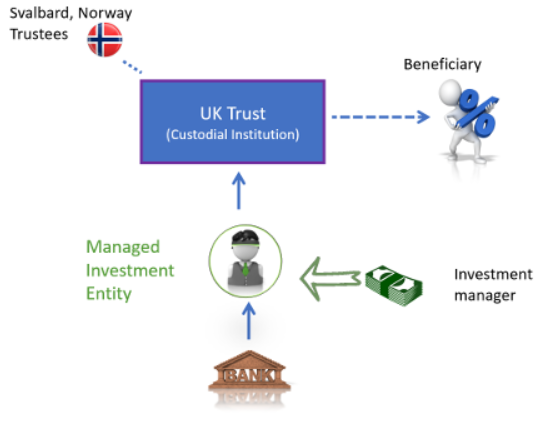
- The recommended structure is a non-UK trust holding a UK company
- The Custodial Institution trustee is an individual, else the CI trust could be categorized as an Investment Entity, and being located in a non-participating jurisdiction would be deemed a Passive NFE subject to look-through by underlying FI.
- Here, the Professionally Managed Investment Entity (shell bank identified by US Finance Committee) legally files a nil report, or no reportable persons as the equity interest in the PMIE is a SPV Custodial Institution
- The SPV Custodial Institution trust does not file anything because Svalbard is not a FATCA participant
- The Custodial Institution does not register with IRS for a GIIN. This has no impact on the CI because it receives no income (it merely holds the shares of the underlying
- The underlying investment entity pays the custodial fees to an unrelated third party
- Note the person of significant control in the UK beneficial owner register for a UK company, is the trustee, and not the grantor, beneficiaries, etc (unless they have control or influence over the company). Note Where the person is a director of a company, including, as:
(a) A Managing director,
(b) A Sole director; or
(c) A Non-executive or executive director who holds a casting vote is a non-exhaustive list of roles and relationships which would not, on their own, result in that person being considered to be exercising significant influence. The right to exercise significant influence or control over the activities of a trust or firm may result in that person being a PSC in relation to the company if that trust or firm would meet the conditions for being a PSC of the company if they were an individual. This would be the case regardless of whether or not they actually exercise that right.
- The US or any other country cannot request information on demand because Svalbard has no DTA with anyone
The best asset protection is always and will always be anonymity. The structure is legally non reportable by BOTH FATCA and CRS. Unlike Cook Islands Nevis and all the rest….
Wait – are you sure?
- Why no GIIN obtained by the Custodial Institution trust? Svalbard is not a FATCA participating territory The CI will not be a participating FFI
- What about the 30% withholding penalty if not registered as a participating FFI? As no income flows up from the investment entity, there will not be a withholding penalty for the custodial institution
- What about recalcitrant account holders? The Custodial Institution has not signed an agreement with the US as a participating FFI. So no recalcitrant reporting
- Is the non-UK trust a FFI if it does not register as a FFI? Yes, because the test for being categorized as an FFI is income based (at least 20% of income is custodian-fee related) and it holds assets for someone else (the beneficiaries). As such, it is an excluded reportable person for the underlying Investment Entity.
Alternate structure
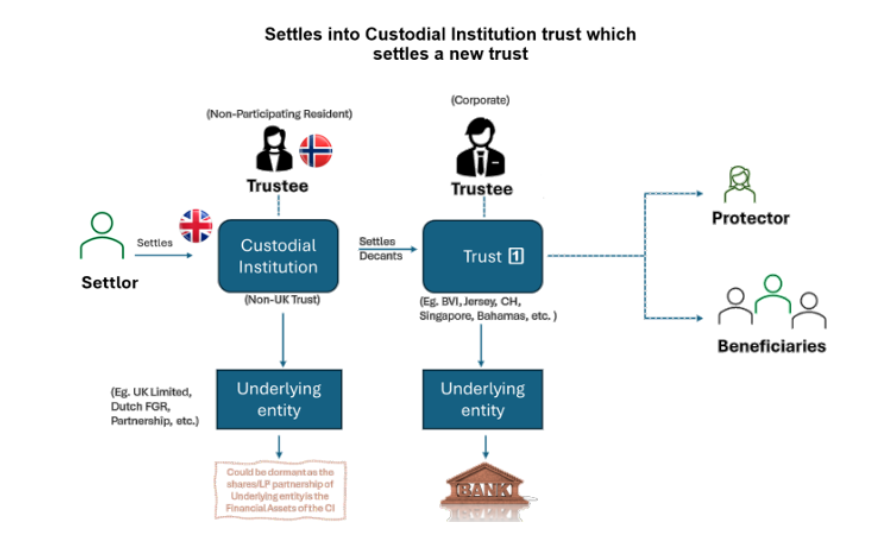
The above structure can be decanted / resettled into a trust of the clients choice.
- The new trust does not report on the grantor because it is a non-reportable Financial Institution, namely a Custodial Institution.
- Even though the Custodial Institution trust is a non-participating FFI, it is an excluded person for reporting for FATCA.
- It is questionable if the Custodial Institution could be the beneficiary, especially if the beneficiaries are an unnamed class of beneficiaries.
What Is “Decanting/Resettling” a Trust in Estate Planning?
- The term “decanting” refers to the process of taking an existing irrevocable trust, creating a new trust that has more desirable terms and provisions, and then moving the assets of the initial trust to the new trust.
- There are many reasons why decanting a trust may be desirable.
- One of the most common reasons a trust decanting is considered is to correct drafting errors made in the original trust document. In other circumstances, changes may be needed to better reflect the grantor’s intentions concerning the trust. Perhaps there was a misunderstanding between what the grantor intended and how the document was written.
- In other cases, it may be necessary to modify the administrative provisions of the trust, combine two trusts to maximize administrative efficiency, or take advantage of investment opportunities. Frequently, there is just a change of circumstances that was not contemplated when the trust was first created. Trust decanting helps accommodate these types of issues.
Common examples you may seek to decant/resettle a trust
- A change in the legal jurisdiction of the trust is desired to enable more liberal investment or asset management powers.
- A jurisdiction change is desired due to more simplified trust administration rules of a particular state or more advantageous income tax treatment.
- A grantor wishes to move to a jurisdiction where trust disclosure is less onerous or allows more privacy.
- A grantor/settlor wishes to change the age of when a beneficiary comes into control of assets or wishes to change a beneficiary designation (for example, because of new additions to the family or a change in relationships).
- A grantor/settlor wishes to modify the terms of trusteeship such as changing their succession order, their investment powers, or how they are compensated, or creating a power to remove trustees.
- A merging of multiple trusts may be desirable to reduce costs and create a better management structure.
- A trust termination date needs to be extended to protect one or more beneficiaries.
If one has a structure that is legally out of FATCA’s scope, is it illegal and penalizable?
- There are no CRS-style Mandatory Disclosure Rules for structures that are out of FATCA’s scope. There are only penalties for not filing FBARs and form 8938.
- General Anti Avoidance Rules (GAAR) does not apply to FATCA
- No such treatment for legally avoiding FATCA
How does one (legally I claim) avoid FATCA, if one is going to file their FBAR by themselves?
- Forget the idiotic “shell bank loophole” identified by the US Senate Committee. It’s not a loophole. It’s just fraudulently lying that there are no reportable persons. That’s not a loophole.
- A loophole is where one can legally claim that there are no reportable persons or not need to file at all.
- The identified shell bank loophole, a billionaire US person was supposed to report on himself, as his entity was a managing Investment Entity, which is a Reporting FI.
- The Senate incorrectly calls the managed Investment Entity a “Shell Bank”.
- Note the underlying company owned by the trust is also a Controlled Foreign Corporation and subpart F / GILTI foreign income needs to be submitted if beneficiaries of trust are entitled or receive more than the threshold amounts.
- Senate Committee Report on the Managed Investment Entity FATCA loophole
This so-called loophole was not a loophole at all but relied 100% on the reportable US Person keeping his head in the sand and illegally not reporting for FATCA, even though he was obligated to do so.
To find out more – email us on help@htj.tax
MADAGASCAR RESIDENCY: OUR 5 – YEAR RESIDENCY PACKAGE – ULTIMATE PLAN B FOR PERSONAL SAFETY, PRIVACY AND WEALTH PRESERVATION
Read article
Lionheart, Military and Cyprus SBA Trusts
Read article
Kenya Residency: Your “Plan B” Guide to Class K and N Visas
Read articleLooking for an international tax service?
We’re always here to help. Don’t hesitate to get in touch.
Talk to an expert